Landing Page Strategy for Paid Campaigns: From Click to Qualified Lead
 September 22, 2026
 Reading time: 7 min read
 Category: Marketing
 1
1
Master your landing page strategy for paid campaigns. Learn message match, page layout, form design, tracking, A/B testing, and CRM integration.
Executing paid campaigns in high-value, fast-paced markets like the UAE requires far more than launching high-converting ad copy and setting competitive bids. When a prospective client or enterprise buyer clicks on an ad, the success of that paid traffic relies entirely on what happens next. A structured landing page strategy acts as the critical bridge between ad spend and qualified lead acquisition, ensuring that every click navigates a friction-free path toward business conversion.
In regional and international markets, buyers demand immediate clarity, relevant value propositions, and precise localized messaging. Capturing qualified leads requires aligning campaign intent with conversion architecture. This guide breaks down the core components of building a resilient landing page framework—from message match and intent alignment to data tracking, continuous experimentation, and seamless CRM handoffs.
Aligning Search and Social Intent with Page Messaging
The primary reason paid traffic fails to convert is message mismatch. Message match occurs when the precise offer, tone, and visual identity presented in an ad creative are seamlessly mirrored on the landing page. If a user clicks an ad promising an enterprise asset management platform and arrives at a generic corporate homepage, cognitive friction instantly increases, driving immediate bounce rates.
Addressing user intent requires distinguishing between high-intent commercial channels, such as Google Search, and lower-intent discovery channels, like LinkedIn or Meta. A search user querying specific enterprise software is evaluating solutions actively. Their landing page must lead with feature clarity, technical specifications, transparent implementation timelines, and precise calls to action. Conversely, a social media user introduced to a brand via a sponsored post needs educational context, risk mitigation, and value-driven offers such as downloadable whitepapers, interactive calculators, or consultation requests.
Designing Modular Landing Page Structures for Maximum Clarity
A high-converting page layout removes unnecessary navigation distractions and focuses entirely on guiding the visitor toward a single decision point. Standard website headers, secondary footers, and unrelated internal navigation links should be excluded from campaign landing pages to retain attention.
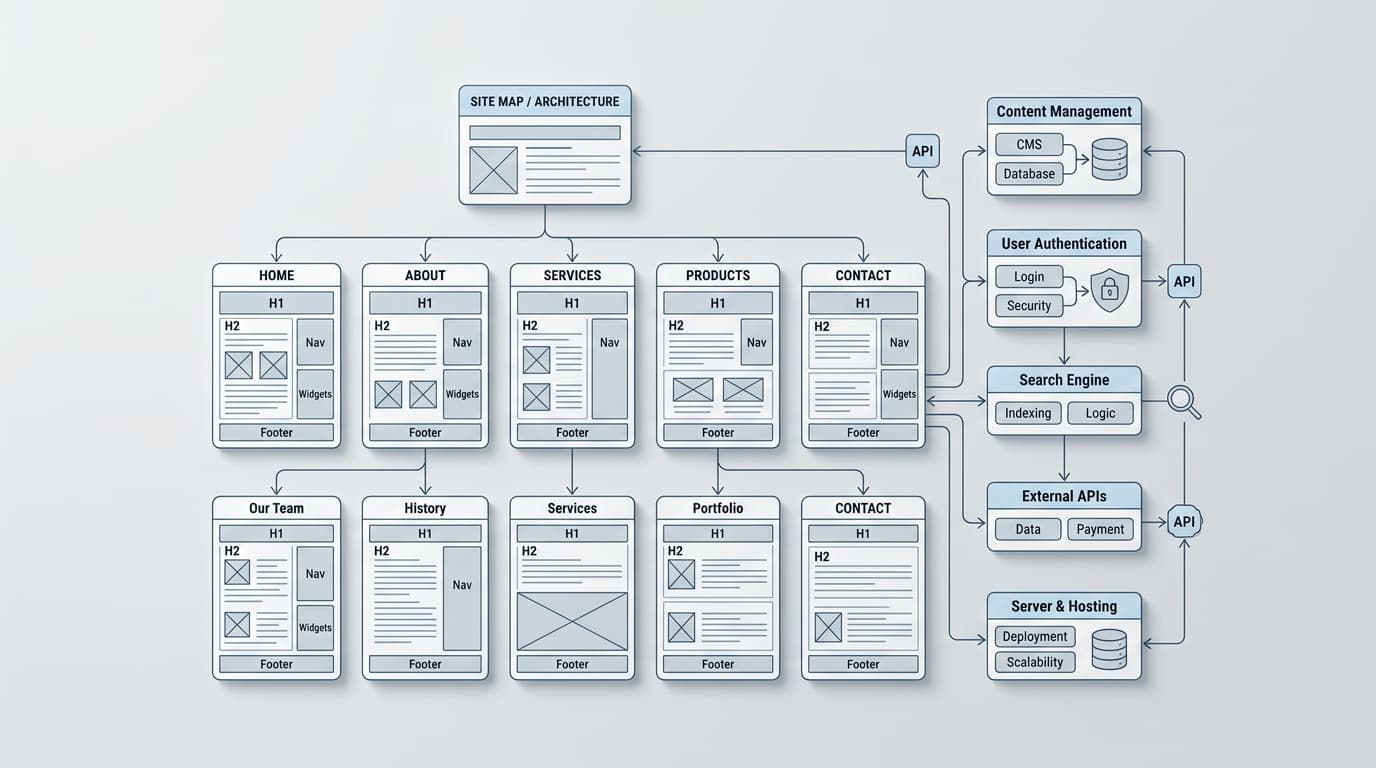
An effective enterprise landing page architecture typically follows a precise structural hierarchy:
Above-the-Fold Value Proposition: A concise headline directly reflecting the ad copy, accompanied by a supporting subheadline, visual proof or interactive element, and an immediate primary CTA.
Social Proof & Authority Signals: Client logos, certifications, partner badges, or brief client testimonials situated early on the page to build immediate trust.
Feature-Benefit Breakdown: A clean, visual breakdown detailing key capabilities, focusing explicitly on pain points solved rather than passive product specifications.
Process and Implementation Visuals: Clear step-by-step breakdowns showing how the solution or service works, reducing perceived onboarding friction.
Secondary Call to Action & Risk Mitigators: A final conversion block addressing common buyer objections, security compliance details, and a clear secondary engagement point.
Optimizing Form Design for Lead Quality in High-Value Campaigns
A common mistake in digital marketing is treating form design solely as a mechanism to maximize submission volume. In performance marketing, receiving hundreds of unqualified leads strains sales teams and inflates customer acquisition costs. Form design must balance user accessibility with qualification filters.
To capture truly qualified leads, progressive profiling and conditional form logic are highly effective. Rather than bombarding visitors with a ten-field form on initial view, multi-step forms break data collection into logical stages. The first step gathers non-sensitive parameters, such as primary goals or industry classification, while subsequent steps collect contact parameters like corporate email and telephone number. Implementing automated business-email validation and company phone fields filters out spam and personal email submissions, ensuring that incoming submissions represent genuine commercial opportunities.
Comprehensive optimization across digital touchpoints requires a multi-faceted digital strategy, where paid acquisition and tailored destination pages operate in complete alignment. Executing an integrated digital marketing strategy ensures that paid traffic flows into systematically engineered funnel environments that reflect brand authority and capture actionable data.
Configuring Robust Event Tracking and Analytics Infrastructure
A landing page strategy is only as effective as the measurement infrastructure behind it. Modern privacy frameworks, browser cookie restrictions, and ad-blockers mean that relying solely on client-side analytics tools yields incomplete campaign data. Accurate decision-making requires robust server-side measurement platforms.
For enterprise campaigns targeting regional markets like the UAE, proper tracking setups must include:
Server-Side Tracking: Deploying server-side Google Tag Manager alongside platform APIs (such as Meta Conversions API or LinkedIn Conversions API) to ensure complete event delivery regardless of client-side restrictions.
Custom Conversion Events: Tracking precise behavioral interactions beyond simple form submissions, such as deep scrolling, video views, form field focus, and downloadable resource clicks.
UTM & Metadata Passing: Utilizing hidden form fields to capture incoming UTM parameters (source, medium, campaign, keyword) alongside browser language, device type, and referral URLs. This metadata should pass directly into your lead management tools.
Frameworks for Continuous Experimentation and A/B Testing
Static landing pages degrade in performance over time due to ad fatigue and shifting market dynamics. Establishing an ongoing optimization framework keeps conversion metrics steady and lowers customer acquisition costs over campaign lifecycles.
When conducting experimentation, marketers must prioritize high-impact structural variables over superficial design tweaks. Testing headline messaging frameworks (e.g., pain-point focused vs. direct result focused), form structures (single-step vs. multi-step), or primary CTA placements produces actionable data faster than altering button colors. Ensure that test variations receive adequate statistical sample sizes before concluding results, and avoid running simultaneous visual tests that obscure which specific variable drove performance shifts.
Integrating Landing Pages with CRM Workflows
A conversion on a landing page is merely the beginning of the sales cycle. The speed and quality of lead processing directly determine whether a digital conversion transforms into closed revenue. Automating the handoff from landing page forms to backend sales systems is critical.
Upon submission, form data should immediately trigger an automated CRM integration pipeline that executes the following steps:
Data Enrichment & Qualification: Augmenting captured lead data with company size, industry classification, and location metrics using API enrichment services.
Automated Lead Scoring: Assigning priority scores based on decision-maker role, company size, and specific campaign entry points.
Instant Sales Routing: Directing high-scoring qualified leads to designated account executives in real time based on territory or service line.
Immediate Confirmation Communication: Dispatching a personalized email response or resource download link immediately, establishing professional trust while the lead is active.
By unifying precise ad messaging, modular layout architecture, strict form qualification, advanced tracking, and automated CRM orchestration, organizations can transform paid digital campaigns into sustainable engines for pipeline growth.
Summary of Core Execution Pillars
Achieving predictable returns from paid digital advertising requires treating landing pages as engineered systems rather than static content pages. Aligning user intent directly with clear value propositions eliminates initial friction. Structuring pages logically, using progressive forms to qualify prospects, capturing robust server-side event data, and integrating forms directly with CRM automation ensures that click volume converts into measurable revenue opportunities across target markets.
Frequently Asked Questions
What is the difference between a dedicated landing page and a standard website page?
A dedicated landing page is built specifically for a targeted advertising campaign with a single, focused objective and no navigation menus that distract users. Standard website pages serve broad discovery purposes, contain multiple internal links, and address varied audience segments simultaneously.
How do multi-step forms improve lead qualification?
Multi-step forms reduce psychological friction by breaking data entry into smaller stages. They allow marketers to collect essential qualifying information—such as budget, timeline, or business size—before asking for personal contact details, resulting in higher quality submissions.
Why is server-side tracking necessary for landing page campaigns?
Client-side tracking often misses conversion events due to browser privacy updates, ad blockers, and cookie restrictions. Server-side tracking routes event data directly from your server to marketing and analytics platforms, ensuring accurate conversion tracking and reliable ad network optimization.
How should UTM parameters be handled on landing page forms?
UTM parameters should be captured dynamically from the page URL and stored in hidden form fields. When a prospect submits the form, these parameters pass directly into the CRM system, allowing sales teams to attribute lead value to specific campaigns, ads, and search keywords.